
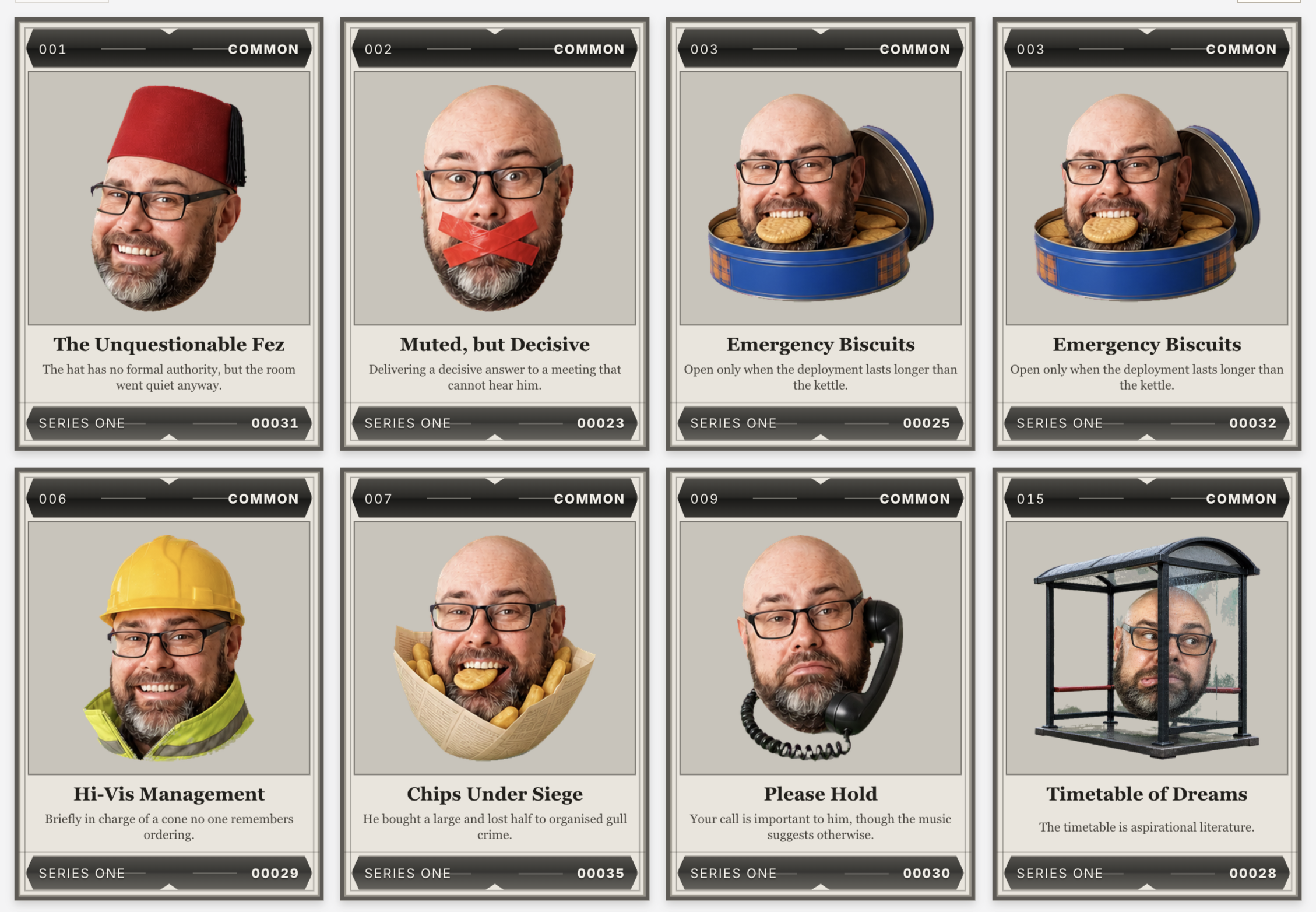
One of our developers has built a trading card game based entirely around me.
This was not on the company roadmap. Nobody asked for it, there was no commercial requirement and, as far as I know, there was no gap in the market for increasingly unlikely versions of my head. It started because the idea was funny and then, as these things tend to do when a developer gets interested, became a proper working application.
The cards include The Unquestionable Fez, Muted, but Decisive and Emergency Biscuits. There are collections, card numbers, descriptions and rarity-style designs. At some point I also appeared inside what looks like a seaside puppet machine, complete with a lifetime pokes counter. I do not remember approving that feature.

A joke with an application behind it
It would have been quite easy to ask an image model for a few strange pictures of me, put the best ones in a group chat and leave it there. This went rather further.
The application has to generate and manage the artwork, give each card a repeatable structure, produce names and descriptions, keep enough visual consistency for the cards to look as though they belong to the same game, and then render the whole thing in a usable interface. Individual cards need to work on their own, but they also need to sit together as a collection without looking like a folder of unrelated AI experiments.
There is a pack-opening screen, because apparently simply being presented with the cards would not create enough tension.
That mix is the interesting bit. AI helped create much of the imagery and written material, but the model was only one part of the build. The rest was normal application work: deciding what data a card needs, creating rules that can be reused, managing assets, building the screens and dealing with the occasions when a generated result is technically valid but plainly not something anybody should keep.
Consistency is particularly awkward. Generative tools are very good at producing another option. They are less naturally inclined to remember that the next option needs to feel as though it came from the same set as the previous 30. A person still has to decide what belongs, what needs another attempt and whether the same joke has now appeared one card too many.
The useful bit of something ridiculous
We spend a lot of time talking to businesses about serious uses of AI: procurement, reporting, document processing and operational systems. Those projects have proper requirements, real data and consequences if something goes wrong. An internal experiment gives a developer somewhere safer to pull the technology apart, try different approaches and find out where it becomes unreliable.
It also makes the limitations harder to ignore. If a card title is slightly odd, that may make it better. If a procurement platform invents a detail, that is a very different matter. The same questions about structure, review, consistency and human judgement still apply, but here we can explore them without interfering with somebody's working day.
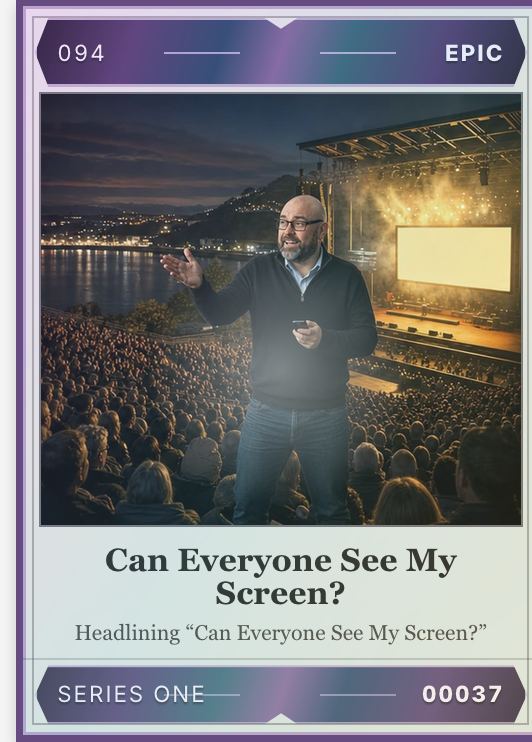
Not every internal project needs to become a product. Sometimes building something strange is useful precisely because nobody is trying to sell it. There is room to follow an idea, notice where the tools help, find the parts they cannot do properly and carry that understanding into more serious work later.
Most public discussion about AI still concentrates on chat interfaces, as though the work begins and ends with asking a model a question. In practice, the useful projects tend to combine generation with application logic, data, design and a fair amount of human decision-making. The generated output has to live somewhere, follow some rules and be useful to the person looking at it.
Sometimes that becomes a procurement platform or an operational reporting tool. Sometimes it becomes a collectible card called Emergency Biscuits.
Askew Brook is not moving into trading cards. I do, however, now have a collection of them and a lifetime pokes counter, which is apparently something the business had been missing.