Present a technical security product range in a way that supports discovery, comparison and configuration.

Servertastic
A long-term software engineering relationship spanning the operational platform, integrations, payments, certificate fulfilment and the next generation of the customer experience.
Most people use SSL/TLS certificates every day without giving them much thought. Behind the scenes, ordering, processing, managing and renewing them requires specialist software that can coordinate customers, products, certificate information, payments and fulfilment.
Askew Brook built that software ecosystem for Servertastic. The relationship began with the operational application and expanded across customer accounts, points-based purchasing, certificate processing and renewals, WHMCS integrations, reseller APIs, order management and fulfilment. We have remained responsible for those foundations as the business and its products have evolved.
The latest stage introduced a new storefront, account experience, Chargebee payment integration and distinctive visual identity. Because Askew Brook also built the systems behind them, these customer-facing improvements could reuse proven business logic rather than duplicate it in a second platform.
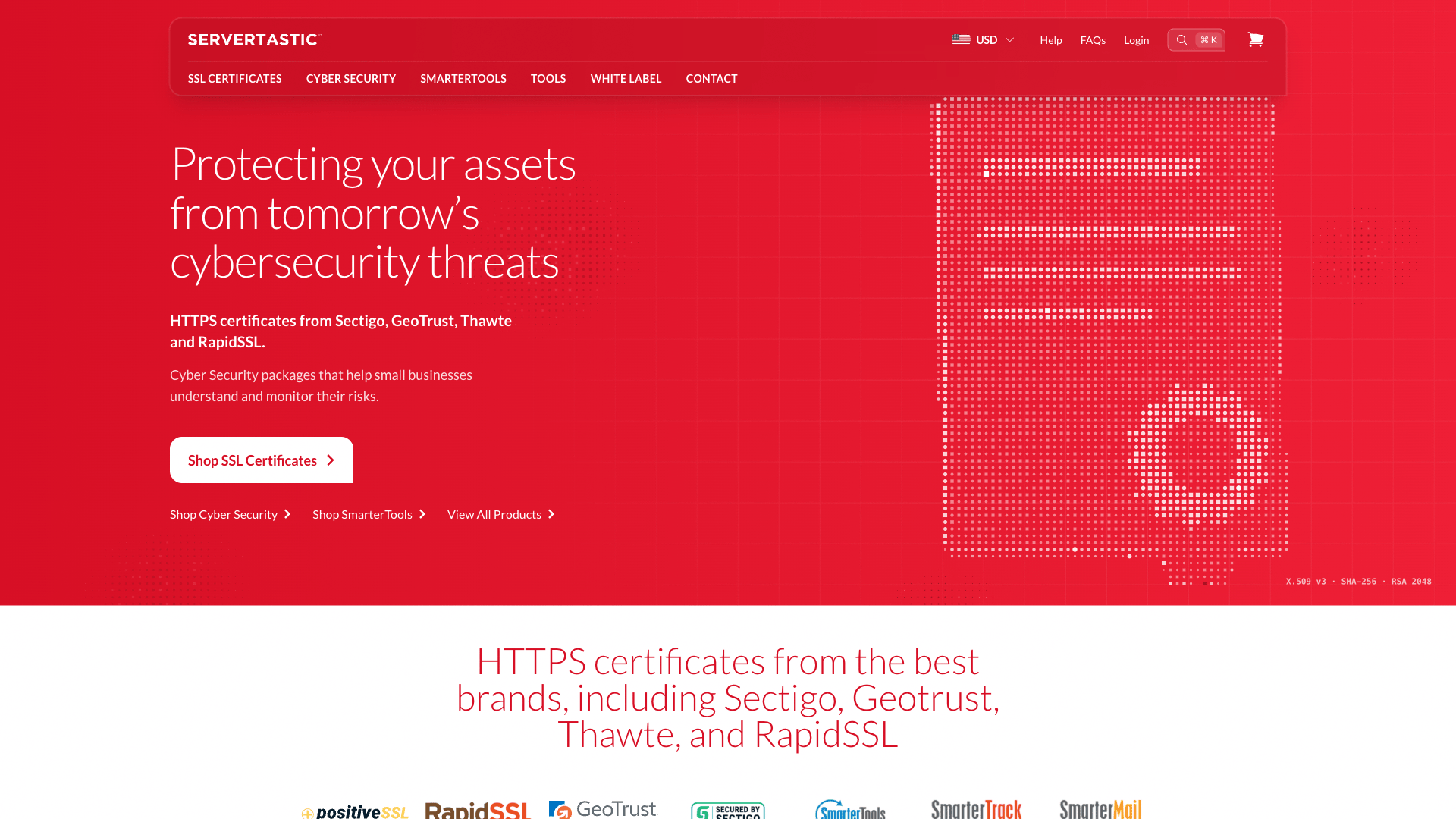
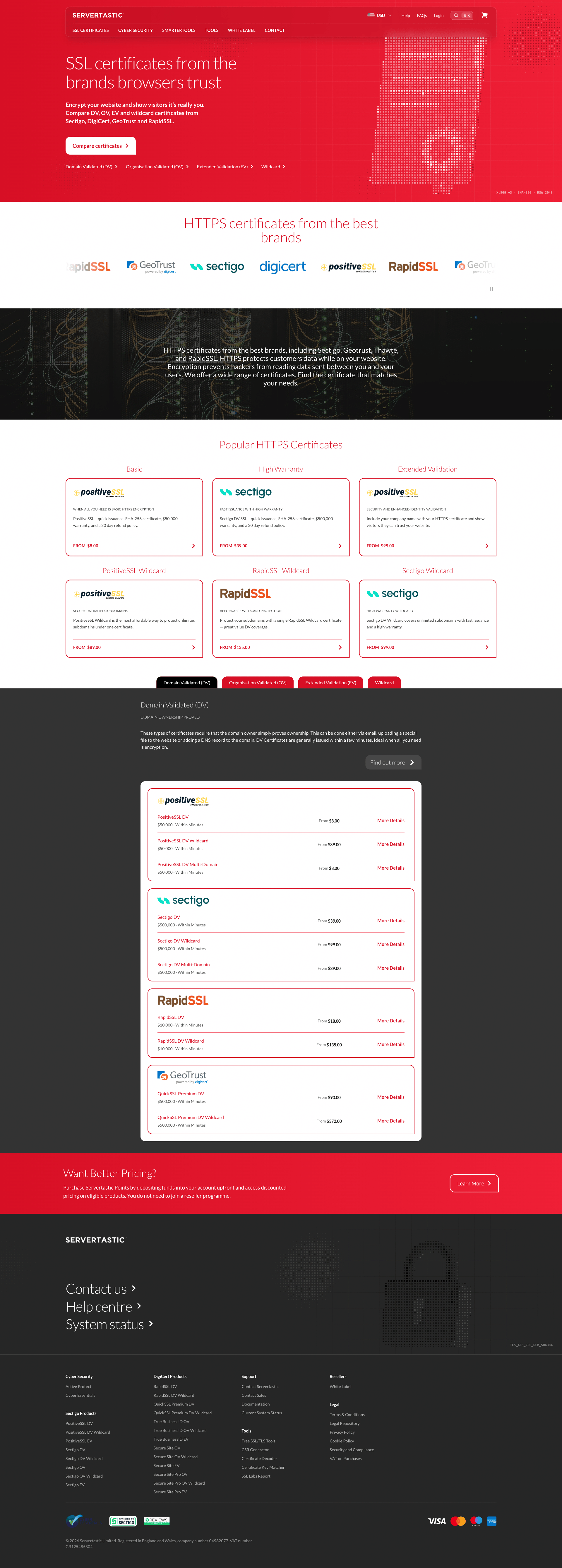
Present a technical security product range in a way that supports discovery, comparison and configuration.
Carry established customer identity, organisation relationships, orders and points data into the new experience.
Retain the operational application Askew Brook had already built for certificate ordering, renewal and fulfilment.
Coordinate Chargebee payments in the storefront with independent verification and fulfilment in the operational application.
Give customers useful order, points and billing tools without creating competing sources of operational data.
Create a strong visual identity that remained responsive, accessible and practical on mobile connections.
Certificate management involves a lifecycle rather than a single checkout. The platform coordinates ordering and product-specific processing, keeps certificate and order information available to the right customer, distinguishes active, expiring and historic activity, and supports the renewal journeys that follow an initial purchase.
Around that lifecycle, Askew Brook developed the reseller connections, account model, points system, APIs and technical utilities needed to make Servertastic’s services usable in practice.
The operational application coordinates certificate orders, product-specific processing, fulfilment, certificate information, expiry states and renewal activity. Customers can follow work beyond the initial purchase rather than treating each certificate as an isolated transaction.
Custom WHMCS modules connect reseller control panels to Servertastic. Alongside them, reseller-facing APIs allow customers to retrieve product information, place orders and manage those orders without requiring Servertastic staff to perform each step manually.
Reseller customers can purchase points, maintain a balance, review its history and use it to fund product orders. Card-funded purchases and points top-ups feed into the same accounting and fulfilment model rather than becoming a separate ordering route.
External integrations expose product and order operations to reseller systems. A separate signed internal API coordinates checkout between the new storefront and the operational application, keeping public integrations distinct from application-to-application responsibilities.
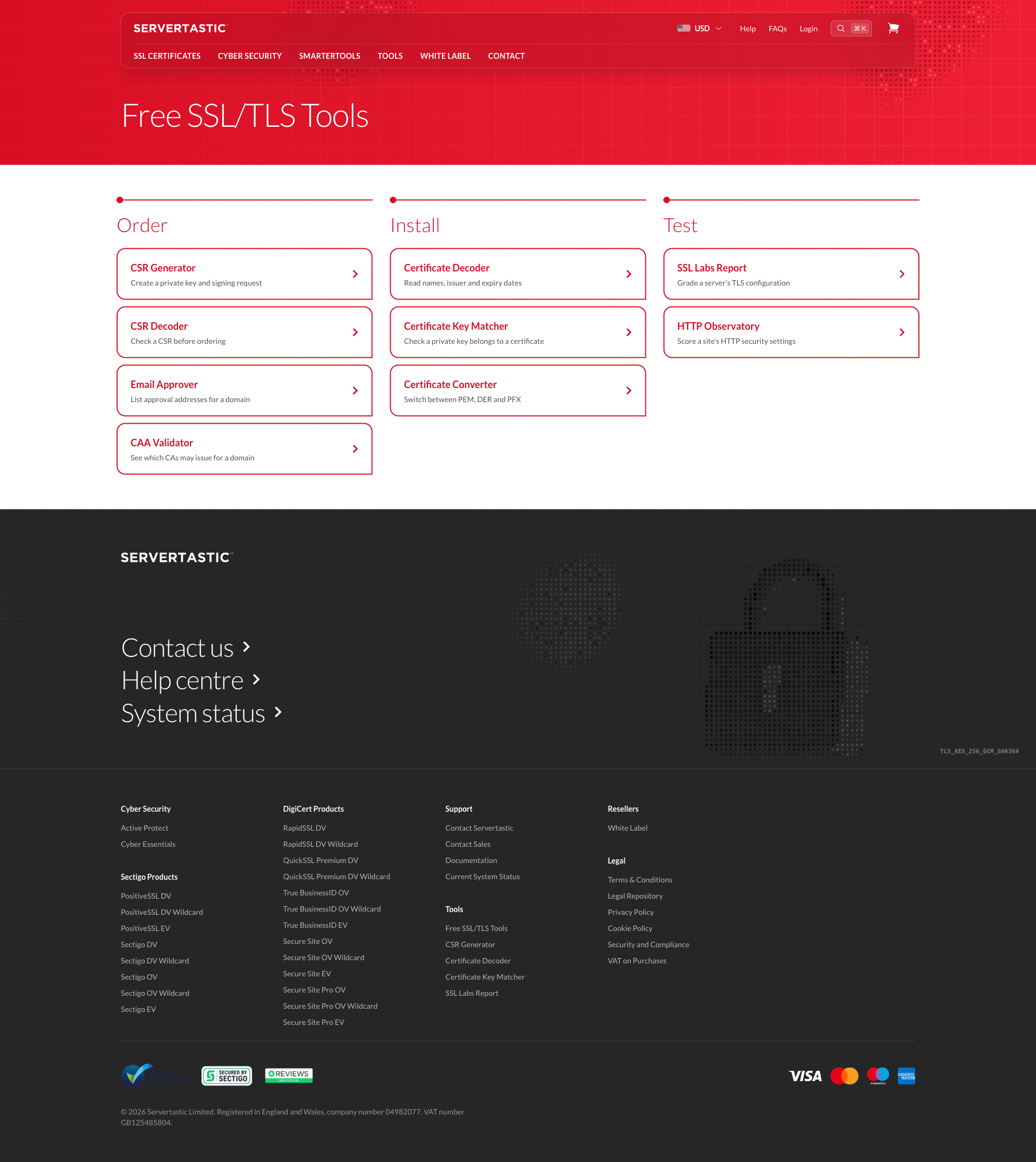
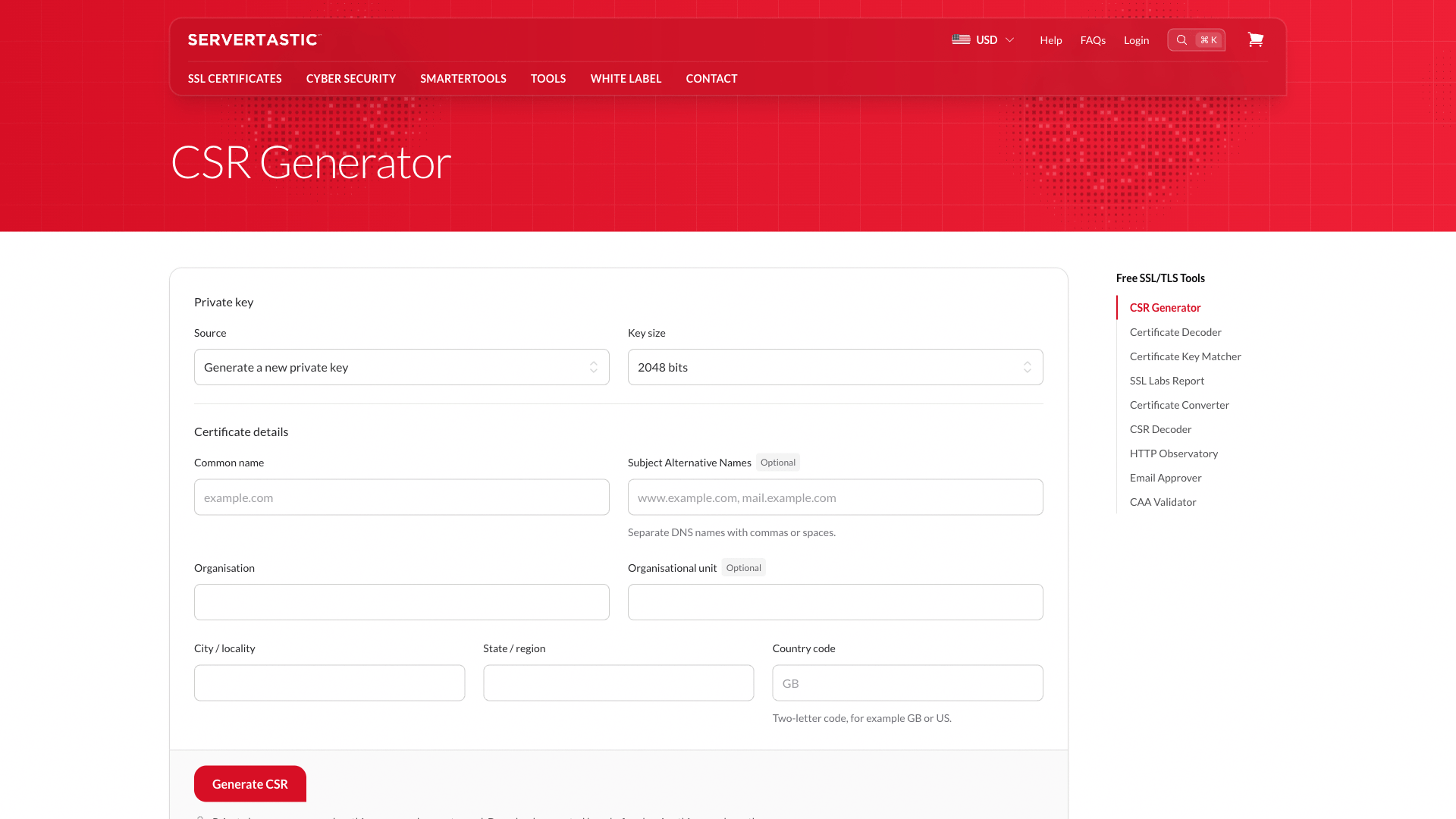
CSR generation and checking, certificate decoding and key matching help customers prepare and inspect the technical material needed around certificate work. They are domain tools built into the wider service, not generic website widgets.
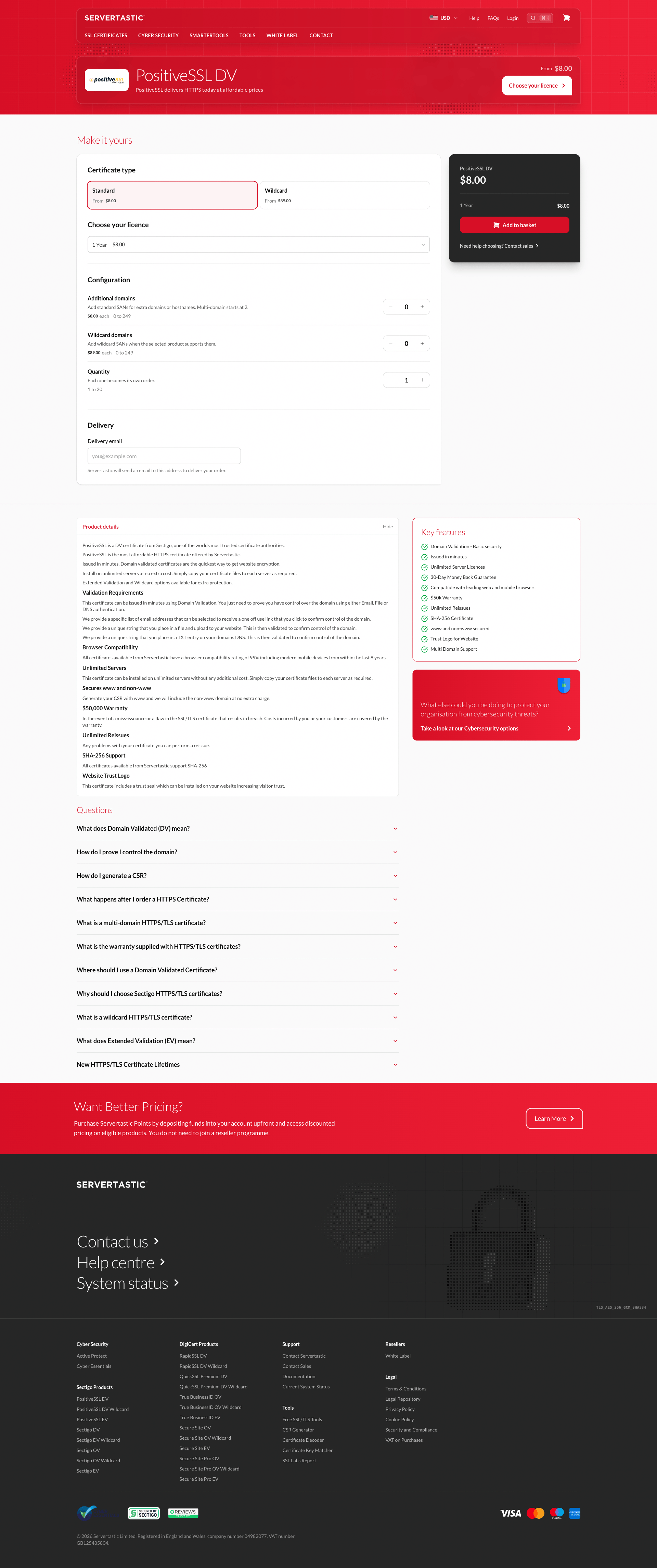
The latest application brings product discovery, configuration, purchasing and organisation-aware account tools into a responsive interface while continuing to use the operational records behind them.
Because Askew Brook built and understood the operational application, retaining its established business logic was an engineering decision rather than a constraint. The new application adds flexibility where it is useful while leaving proven fulfilment responsibilities with the system designed to perform them.
The customer sees one coherent Servertastic experience. Behind it, each application has a clear responsibility and important information has an authoritative home.
The applications use the same customer records and compatible Laravel sessions, while membership checks determine which organisation’s orders, domains, certificates and points information a customer may access. Statamic administration remains separate from customer authentication.
Statamic controls how products and editorial information are presented. Operational identifiers, points costs, supported options and fulfilment rules stay with the platform built to manage them, avoiding competing versions of important business information.
Signed server-to-server checkout requests are tied to the initiating customer and organisation. The storefront handles the Chargebee interaction, while the operational application verifies the paid invoice before points accounting and fulfilment begin.
Clear boundaries allow the storefront and operational application to change at different rates. New customer-facing capability can be introduced without duplicating the operational platform or forcing every improvement into one tightly coupled codebase.
A successful payment and completed order will not always happen in one uninterrupted request. A customer may pay successfully just before an application process stops or a network call is interrupted.
The architecture records the checkout, verifies the paid invoice independently and uses idempotency, locks and scheduled recovery so completion work can be retried without casually processing the same transaction twice. The storefront owns charging; the operational application owns points accounting and fulfilment.
The homepage animation is a custom JavaScript renderer using the browser’s Canvas 2D API. Locks, shields and certificates are described mathematically as three-dimensional forms, then rendered through a field of halftone dots. The globe uses its own procedural sphere, grid and orbiting detail.
Custom ray marching, surface lighting and a scanning transition give the sequence its depth and rhythm without relying on a general-purpose 3D engine or downloaded models. The same visual language is reused across the storefront to make the design recognisably Servertastic.
The implementation also accounts for the real page around it: geometry responds to available space, device pixel ratio is capped, expensive samples are cached, offscreen animation work stops, and reduced-motion visitors receive a still composition.
The animation is prominent because it belongs to the brand, but the navigation, copy and calls to action remain semantic HTML rather than being painted into the canvas.
Servertastic demonstrates what a long-term software engineering relationship can deliver. From the original operational application, reseller APIs and specialist integrations through to the latest storefront and customer experience, Askew Brook has designed, developed and evolved the technology supporting the business.
New requirements have not been treated as disconnected projects. We have been able to build on systems we already understand, preserve established operational responsibilities and introduce new capabilities where they belong. The result is an ecosystem that combines substantial back-office engineering with customer-facing design and specialist frontend craft.
Need one team to build, connect and evolve the systems your business depends on?
Talk to us about your systems →We will give you a straight answer on how we can help. No pitch. No template proposal.