
We do a lot of work with local schools and colleges, even working with the Careers & Enterprise Companies as a Cornerstone Employer but one thing we never really mastered was offering work experience. Don't get me wrong we had done it in the past, we had some excellent students join us for a week. We'd found spare equipment, a desk and rearranged our diary to fit with the one week a year that schools want to place students but work experience as a model isn't set up for companies like ours.
We have been quite vocal to anyone that would listen about finding a better way for smaller companies to provide work experience and Covid, eventually, has provided us with the opportunity to walk the walk and not just talk the talk. As we're now working remotely, anyone who wants to work with us has to work remotely too; enter Serhii.
Serhii, who is sixteen and moved to Scarborough with his family five years ago, contacted us directly to ask for work experience. When anyone goes out of their way to work with us we try to find a way to say 'yes'; but it helps that he is very interested in programming and he has achieved more than most job applicants we interview, despite his age and being largely self-taught.
So, how do you manage work experience without them being in the office? The first hurdle was getting sign-off from the relevant people. All of the forms that people need to complete, health and safety visits and general checks that schools and colleges have done for decades are largely irrelevant. I'm sure this feels scary to everyone involved but it is truly freeing, our students can get work experience anywhere they like from their own homes. Plus they learn the value of being self motivated compared to being tightly controlled in an office as it can feel at times.
Once Serhii joined us we treated him exactly like any other employee, he was added to our comms channels, invited to our weekly team meetings and integrated as much as possible into the group. We wanted to show him what working life was like just as much as the job role so we tried to expose him to as many situations as possible. We also took him to visit some of our clients to give him exposure to other businesses in the town, he was particularly impressed with the team over at Anglo American who gave up a lot of their time to talk about what they do day to day.
The main issues we have with all work experience who are with us for one week are 'how do you show the whole process we go through when projects can last months and months?' and 'How can a company of our size give our learners the time they need?'. I must caveat this; it will only work if the learner is driven and engage but we structured it like so:
Long term task
Due to Serhii's education and personal interests he has some experience working with sensors and RaspberryPi's. We explained the technology stack and asked him to try and integrate what he already knew into that. This is a win/win, we get some R&D and Serhii gets to make his previous work integrate with commercial applications.
This was Serhii's task and we expected him to do his own research and ask us questions just like all our developers work. I thought this was tough and a long shot, it turns out he completed it in three days.
Short term tasks
Scattered throughout the week we placed shorter, more structured tasks, designed to allow us to explain to Serhii how we as a modern software development company work. The idea was, he may not do this on placement but it will show him some new tools, open up new possibilities and ultimately get him ready for his next step, wherever that takes him.
We had one hour sessions looking at project management, wire-framing, requirements gathering and version control with the member of the team that is best placed to explain what is involved. We also involved him in as many client meetings as possible, not expecting him to contribute but it allowed us to show Serhii why we do things the way we do and ultimately allow him to get more exposure to different companies.
In summary, running a remote experience placement is undoubtedly challenging. I'm sure there are times when we let Serhii drift a little too much, but ultimately exposure for the next generation to companies like ours is key. This is probably even more important in towns like Scarborough where we need to show what is possible for our young people. I've no doubt that work experience needs to change and the model that exposes the learner to multiple companies has to be beneficial.
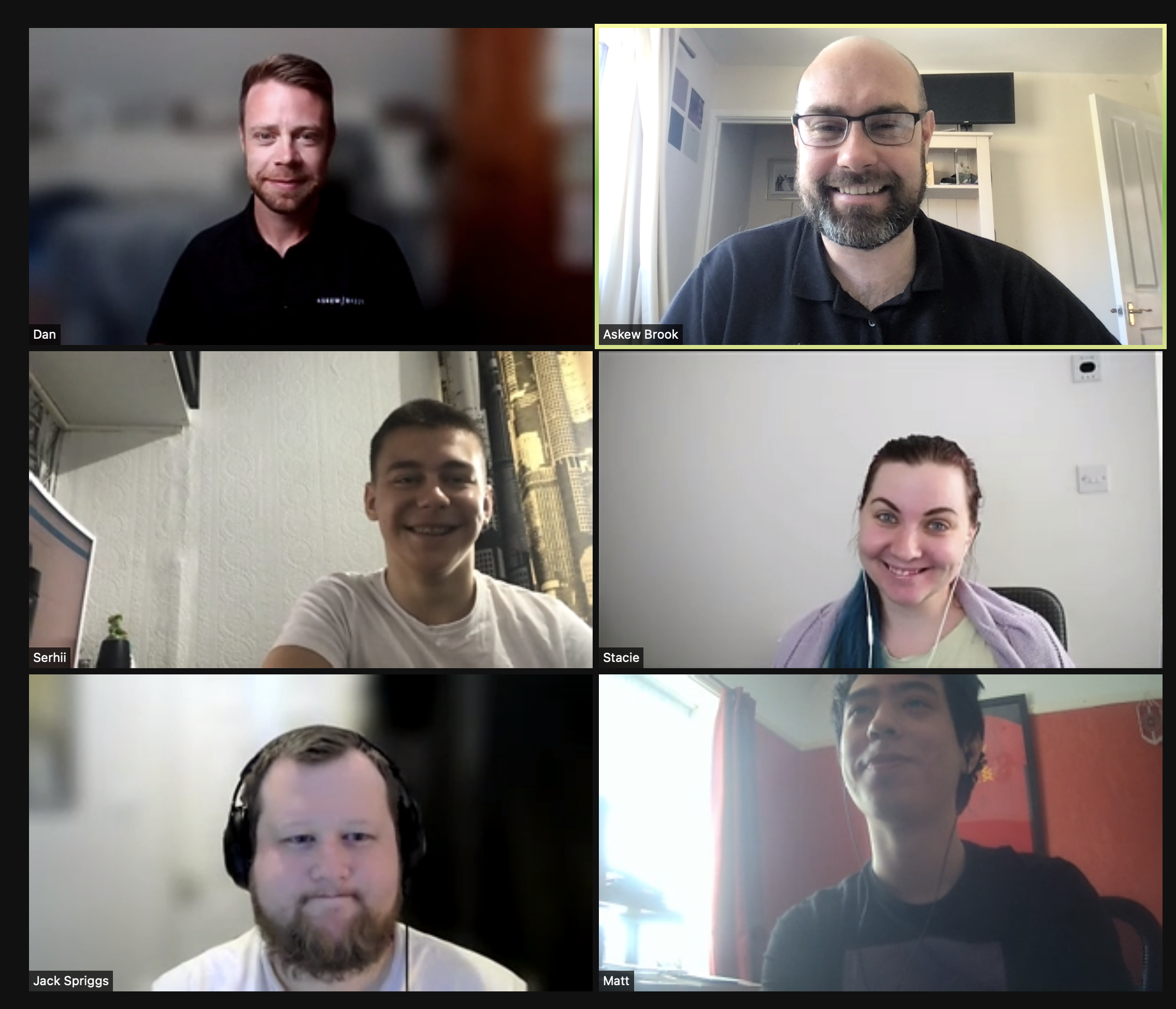
"During my time at Askew Brook, I found myself being challenged to expand upon my previous skill set, while integrating it within an industry standard web development framework. I could tell that my tasks were tailored to my interests and abilities, which made me so much more engaged in the process. And if I struggled, I always had the opportunity to ask for advice from undeniable masters of the craft. While also having the freedom to explore some of my other interests within the industry, due to the flexibility of the workplace.
A big part of working at Askew Brook is client relations, which I got to experience first hand by being invited to the customer meetings. It taught me the importance of managing customer expectations while attempting to provide the best service possible. Speaking to Dan, the project manager, showed me a different side of the business. I have come to realise how crucial it is to have a level of structure even at a relatively small company, as it helps developers be more efficient and impactful with their time.
Lastly, I got a taste of the corporate world during my visit to Anglo American, who are one of the bigger clients of Askew Brook. This showed me a real contrast in working as a small team, compared to working within a larger system, which has helped me decide which way I want to move forward. Overall, I am really thankful to Askew Brook for letting me have this work experience. It was really difficult to find something relevant in a small place like Scarborough, and they greatly exceeded my expectations with such an insightful and challenging week."